
Garifuturism Royal Publishing House
Anansi Interviews the Water Keepers of Toledo
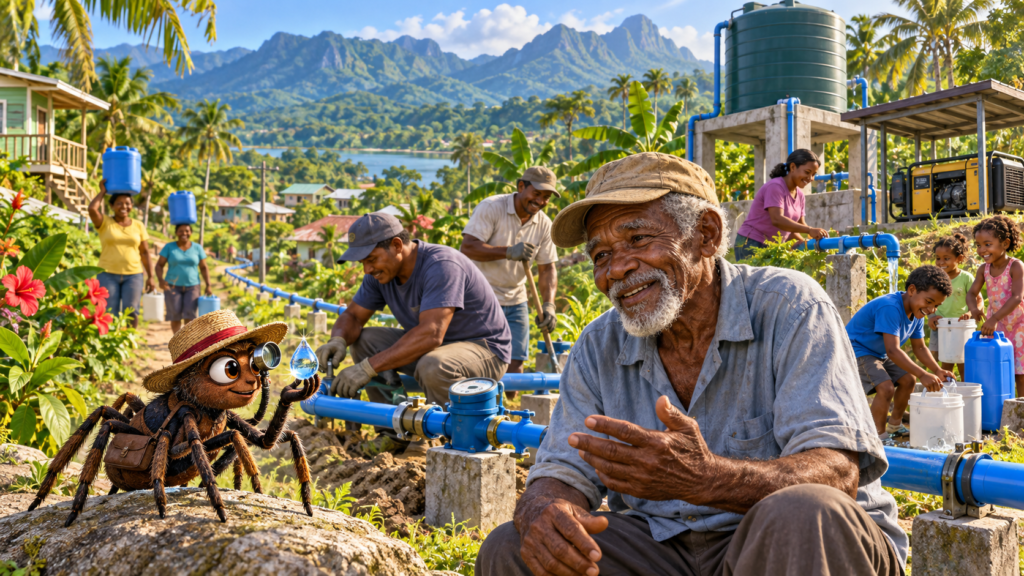
Anansi traveled to Toledo because he heard fourteen villages had received treasure.
He arrived at Machaca Forest Station wearing a jeweler’s loupe, carrying a velvet pouch, and whispering the market price of gold to himself.
Instead of ingots, he found high-grade pipes. Instead of loose diamonds, he found water meters. Instead of a golden crown, he found a heavy-duty generator intended to support resilience in San Jose Village.
“Where is the treasure?” he asked a water-board elder.
The elder turned a valve. Clean water ran through a pipe toward homes.
“There,” she said.
Anansi held one drop beneath his loupe. It caught the morning light more cleanly than any stone he had planned to steal.
“What is its carat weight?”
“Enough for a child to drink.”
“What is its resale value?”
“Ask the family that no longer carries every bucket the old distance. Ask the school day that begins with water. Ask the health post, the farmer, the cook, and the small guesthouse.”
Anansi opened his notebook. For once, he conducted an interview instead of interrupting one.
Members of village water boards explained that hardware alone would not manage itself. Pipes need maintenance. Meters need administration. Generators need fuel and care. Boards need training, records, trust, and community participation. The work was both technical and social.
“So the treasure has guardians?” Anansi asked.
“Stewards,” the elder corrected.
He visited Yemeri Grove, San Vicente, Blue Creek, Big Falls, Graham Creek, Bella Vista, San Pedro Columbia, San Antonio, Jordan, Santa Teresa, San Felipe, San Pablo, San Isidro, and San Jose in his imagination, tracing the names like beads on a national necklace.
At last Anansi put away his velvet pouch.
“I cannot steal this jewel,” he said. “It belongs to everyone only when everyone keeps it working.”
The moral: The brightest treasure is not the thing locked away. It is the system a community can sustain and share.
What this means for tourism and local industry
Reliable water supports health first. It also supports schools, food preparation, farms, homestays, small accommodations, craft workshops, restaurants, and community tourism. Visitors rarely see the water system behind an experience, but local enterprises feel every interruption.
Development storytelling should not turn rural communities into scenery. It should recognize local water boards, community labor, maintenance, administration, and long-term ownership. Be Belize jewelry can connect buyers to place and memory, but no pendant substitutes for infrastructure. The respectful product bridge is pride in Belize, paired with honest attention to the people who keep Belize working.
Jewelry humor from Anansi’s counter
Anansi tried to set a water droplet in a ring. It slipped through every prong and improved the garden. The elder told him this was the correct setting.
Source boundary
- UNICEF Belize and the Government of Belize identify the fourteen Toledo communities and the piping, meters, and San Jose generator delivered through the initiative.
- UNICEF Belize’s Water Boards Training Manual overview explains the community-management and sustainability role of village water boards.
Carry the story home
Jewelry connected to this Belize story
These live Be Belize pieces were selected for this story. Product availability, materials, sizing, and custom options should be confirmed on the product page.
New Belize Anansi releases
Receive the next story when it is released.
Join the Be Belize story list for new Belize Anansi tales, cultural notes, and jewelry releases connected to home and diaspora.