Garifuturism Royal Publishing House
Anansi and the Crocodile Who Feared the Crowd
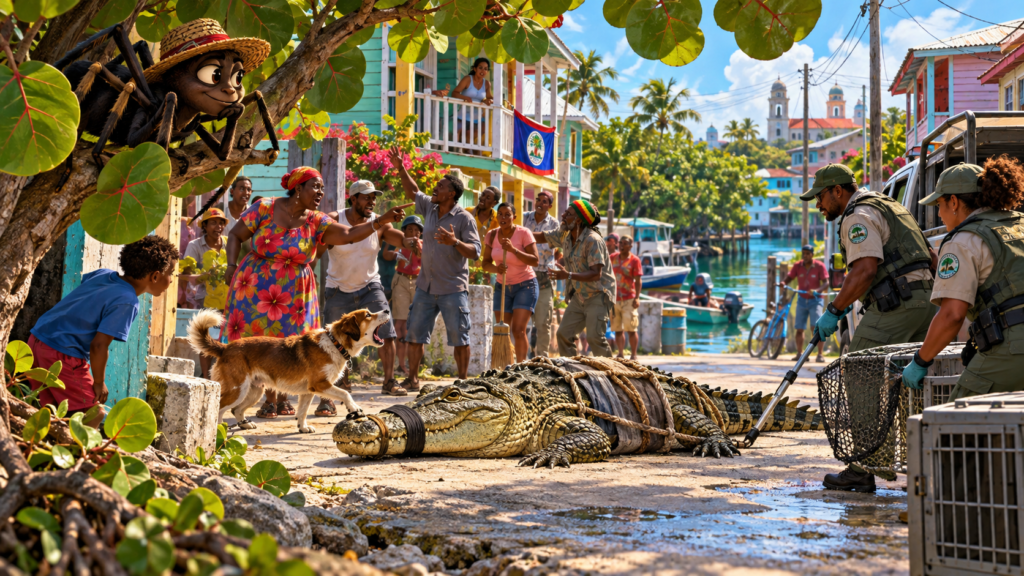
The afternoon heat on Dolphin Street was thick enough to chew. In the shade of a sea grape tree, Anansi adjusted his straw hat and prepared to enjoy the one thing he never had to purchase: other people’s business.
Below him, a crowd gathered around a crocodile that had been captured and restrained. The animal did not ask for an audience. It did not request a livestream. It would have preferred the canal, a quiet bank, and for every phone battery in Belize City to fail at once.
Then an argument broke out beside it.
“Imagine,” Anansi whispered, “a crocodile tied up while the humans become the wildlife.”
The quarrel grew. People shouted. Cameras rose. Two women began fighting near the restrained animal, and the crocodile tried to move away from the commotion. For the first time in its long reptilian life, it looked toward the humans and thought, Those creatures are dangerous.
Anansi dropped from the branch and introduced himself as Doctor Web, Specialist in Public Relations and Emergency Jewelry Appraisal.
“Who hired a jeweler?” someone demanded.
“Nobody,” he said. “That is why my fee is affordable.”
He examined the wire around the crocodile and shook his head. “This is not sterling silver, it is not properly fitted, and the client did not consent. I cannot recommend it.”
When trained responders arrived, Anansi’s performance ended. Police and wildlife volunteers took control, removed the makeshift restraints, secured the crocodile properly, and moved it away from the populated area. The animal had minor wounds believed to predate the incident and was released into suitable habitat.
Before leaving, the crocodile looked back at Anansi. “You think you are clever,” it said.
“I am a professional,” Anansi replied.
“Then tell them this: a wild animal is not a prop, a fight is not tourism, and a viral video is not a plan.”
Anansi removed his hat. The crocodile had delivered the better closing line.
The moral: When spectacle takes the place of judgment, even the creature called dangerous may be the one needing rescue.
What this means for tourism and local industry
Belize’s wildlife is part of its ecological wealth and visitor appeal. Responsible tourism depends on communities, guides, businesses, police, and conservation groups treating animals safely and protecting residents at the same time. Viral disorder can flatten a whole neighborhood into a punchline; responsible reporting can instead teach coexistence, emergency contacts, and respect for protected species.
Local artisans and jewelers can celebrate crocodile, mangrove, river, and coastal imagery without encouraging unsafe encounters. The honest product story is conservation, habitat, and skilled Belizean design, not possession of the wild thing itself.
Jewelry humor from Anansi’s counter
Anansi advertised a crocodile-proof bracelet. The crocodile read the warranty and returned it. “This protects only the seller,” it said.
Source boundary
- Breaking Belize News reported the rescue, the Dolphin Street location, police review, and Crocodile Research Coalition response.
- 7 News Belize reported police confirmation that the Cybercrime Unit was reviewing the viral fight video.
- Belize Forest Department advisory via The San Pedro Sun urges the public not to feed, approach, or interact with crocodiles.
Carry the story home
Jewelry connected to this Belize story
These live Be Belize pieces were selected for this story. Product availability, materials, sizing, and custom options should be confirmed on the product page.
New Belize Anansi releases
Receive the next story when it is released.
Join the Be Belize story list for new Belize Anansi tales, cultural notes, and jewelry releases connected to home and diaspora.